Matienzo Caves Project 2026
News and cave exploration around Matienzo during 2026
A map with area names can be found here.
Section links • Easter • post-Easter • Summer • Autumn • Christmas period
Pre-Easter
In a groundhog-day moment, the pre-Easter tranquility was again broken by announcements that the 4 wind farms proposed last year, now had a version 2 documents and were up for re-consideration. Three of these would directly impact areas which were either in our previous or current permit areas. The sites are
• Moncubo (3 generators - affecting the areas around Monte Llusa, Cierrolinos, Garzón, Villanueva and El Rincón in the municipalities of Hazas de Cesto, Solórzano, Ribamontán al Monte and Meruelo)
• Sierra de Sel (10 generators - affecting areas around Ogarrio and San Miguel in the municipalities of Ruesga and Voto)
• Fuente Pico (3 generators - affecting areas around Llueva and San Miguel in the municipality of Voto)
Detailed, 'version 2' responses on behalf of Matienzo Caves Project concentrated on the, once again, inadequate Environmental Impact Studies. In these documents (each over 1000 pages) virtually no mention was made of karst or damage to the underground ecosystem. Misleading statements (i.e. a pack of ill-informed lies) were also made about decommissioning: "the landscape will be restored". Some of the information and concerns supplied by the MCP last time were inserted into the proposer's altered documents, but were "bolted on" with some commentary and with no mitigating actions.
In addition, an environmental report - part of a proposal to build a battery facility at Fuente las Varas - was seriously defective. There was no mention of the 79km-long 4 Valleys System underlying the proposal; ground temperature was estimated at 30°C and water was thought to drain to Aguanaz rather than Secadura.
All four 'alegaciones' have been submitted to the
Federación Cántabra de Espeleología and sent to town halls and other organisations with an invitation to use the presented information in their own objections as they wish. The documents were also submitted as formal 'alegaciones' to the Cantabrian government thanks to Helen Unger Clark from Ogarrio.
Using AI to create lyrics from documents and then music allowed the speedy production of some "protest songs" (in English and Spanish) which were shared. AI has also opened up wider song production, extolling the virtues of Matienzo, the karst and underground and the various threats that are happening with depressing frequency. A Song Library page has been created with an open invitation for songs, live or with AI prompts.
Tony Brocklebank - 'Bottlebank' to his mates - passed away on 6th March 2026 at the age of 62 after a long illness.
Tony's first brush with Matienzo came in the summer of 1993, when explorations in Torca del Regatón were in full swing. He took to the valley immediately, finding his niche among the diggers and pushers with easy confidence. However, a decade passed before he returned - and the Matienzo bug had well and truly bitten.
From the summer of 2003 onwards, when he explored a promising new site (1935), he became a regular fixture on expeditions, often caving alongside fellow members of the Derbyshire Cave Club. From the summer of 2008 he was joined by his partner Sue, who later became his wife - the couple even holding a 'wedding' ceremony and party in Matienzo itself in the summer of 2012. The place had woven itself into their lives.
What marked Tony out was his enthusiasm and tenacity. At Easter 2007 he was digging in Cueva Torno, trying to find a shorter exit route for a recently discovered human skull. At Easter 2008 he was at it again in Cueva del Zorro. By Autumn 2008 he had joined the cavers based at Bar Tomás, helping to explore new sites around Hornedo and Barrio la Mina. He was the kind of caver who brought energy and commitment wherever the work took him.
Easter 2010 saw 'Bottlebank Tours' - a series of trips digging out various entrances around Fuente Aguanaz and Torca la Vaca, one of which yielded the discovery of Torca de Peña Encaramada. By Spring 2011 he was involved in digs around Cueva Laberinto at San Antonio, and by Christmas that year he was searching for new sites above El Cubillón at Moncobe and digging site 3215 above the Duck Pond sink at Camposdelante.
His contributions in 2012 were perhaps among his most significant. He helped investigate sites in the Piluca area at Easter, before throwing himself into the excavation and exploration of site 0289 and Lenny's Cave in Secadura - a cave with a large phreatic tunnel - and searching the woodland above it. At Christmas he returned to Lenny's Cave, hunted for new entrances above Torca la Vaca, and found site 3784, which contained an almost complete horse skeleton. He also helped to document six new sites on the north side of the Llueva valley.
His final caving visit came at Easter 2013, when he returned to dig above Lenny's Cave at sites 0291 and 0292. He parted ways with the expeditions that season over disagreements about how things were being reorganised - a reminder that the human side of caving, like the underground itself, is not without its difficult passages.
But the record of what Tony gave to Matienzo stands clearly in logbooks, site descriptions, new discoveries, patient digging, and years of good company both on the hills, in Casa Germán and underground. Gone too soon.
Rest in peace, Bottlebank.
A pdf summarising Easter activities can be viewed here.
Introduction
Over 30 cavers came to Matienzo and, along with partners and children, this meant over 40 people were visiting the area, with a lot camping behind Casa Germán. The weather was poor at first with mainly light rain making the campsite wet, but later it dried up with some nice warm spring weather. Water levels were high to start with, preventing work in Fuente Aguanaz in the first week of the expedition.
Our permit for 2026 was late coming, along with others in Cantabria. This was due in part to ongoing negotiations between Cultura and the Federation about the need for using the 112 call out system for expeditions with permit areas. In the event an agreement was not reached and the call out system is still in place. Our permit arrived at the end of the expedition period.
In our newer area to the NW more work is still needed in the Hazas de Cesto and Ribamontán al Monte areas as far as the N642/A-8 motorway where jungle bashing is the main obstacle for finding new sites. However, the dog rescue at a previously unknown shaft shows new sites in this area exist – discussion with the local hunters could be productive in finding these.
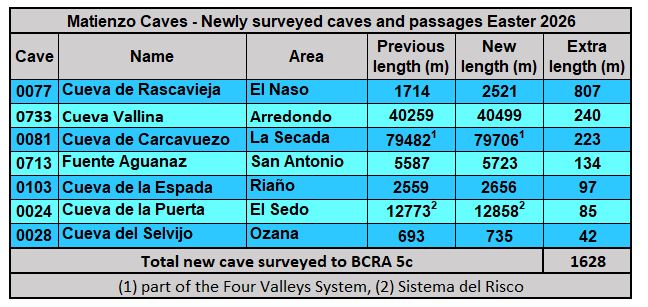 Just over 1600m of new cave were found over Easter. The most productive work was in Cueva Rascavieja where, despite the main way on not being found, over 800m of new cave was added to this important system. Another key find was extending the Western Series in Cueva de Caravuezo by over 200m when Mark Smith dived through the end sump in the Western Series. This find seems not to go to Cueva de Bollón as expected but into a blank area to the north. Other finds were mainly split between Cueva Vallina, Fuente Aguanaz and Cueva de la Espada. Thirty-eight new sites were recorded.
In addition to the prospecting / surveying work, Hollie London sampled cave invertebrates as part of an authorised project allowing samples to be taken back to the UK for detailed analysis. A separate report will follow when this analysis is complete.
S O U T H E R N S E C T O R
Arredondo
Nine trips took place in Cueva Vallina (0733). A team pushed and surveyed leads in the area of the chamber to the NE of Resistance Gallery. One crawl went to a tight pitch and up into "This is NOT A Wetherspoons" and then up the 12m pitch and traverse to drop James's Drive (20m). A window to a chamber followed then 20m along a very tight crawl (Dog Horizontal). Even a small caver found this a little claustrophobic, but it is still going, very tight.
A promising lead beneath the traverse line went on to the right into a sandy crawl which ended in a small 1.5m climb down into a heavily calcited aven which had audio and visual connection to the top of James's Drive.
Continuing down and past antler formations a 3m climb down led into a small chamber which was the bottom of James's Drive. Here the stream continued into the bottom of a tall tight rift. After some work it continued with the floor getting deeper as the stream meandered. It continues tight and needs pushing.
On further trips a 10m slanted pitch went to a 20m crawl to a short waterfall with the way on too tight to continue. Elsewhere, the 12m climb ended in an upper passageway going off some 30m to where the end could not be seen. From the top of the aven there was a 20m wet pitch with the water at the bottom going through small slots in the floor. Up the pitch a phreatic passageway headed east and continued for about 20m to a corner and to a short section of narrow passages to a choke. About 6m down the pitch were some rusty spits. However, at the top there was no evidence of the previous exploration.
The higher areas were pushed by bolting around the pitch head. There was lots of clay along the walls, which kept falling off the pitch making bolt placement difficult. The passage continued for 20m to a clay plug. An aven in the wall needs a few bolts to climb up and is a minor lead. A window some two thirds the way down the 20m pitch led to a small passage heading north needing a thin person to push. A small crawl near the bottom and a 12m aven was pushed and appeared 8m up in the roof on the opposite side of the chamber.
There are still open leads in this area:
1. Aven at the far north end of the upper passage. 2. Possible continued dig at the far north end of the upper passage, should it be considered a key direction. 3. Slots in the floor of the 20m pitch. 4. North bound passages beyond the pit through the window on the 20m pitch.
From the top of 12m aven, another traverse to avoid bolting up a calcited wall, heads south towards the top of the first inlet. In total just under 200m of new survey was completed.
In the Shatter Passage area, a few leads were pushed and 47m was surveyed.
At the Resistance Gallery area, a number of leads were examined. At Far End Chamber a short sandy crawl (marked on survey as continues) led to a 10m loose pitch followed by another pitch of about 10m where it looks large beyond – this needs more work and survey.
In this area on the left is a lead that looks to go small and tortuous but was too wet to investigate. On the right side of the chamber an opening which looks to not have been investigated and appears to be about 15 m down to what looks like quite a wide streamway, but loose rocks need removing before pushing further.
Invertebrate sampling took place in the streamway below Double Dutch Pitch where numerous shrimps were collected in areas where there were few or none last year. The area around Birds World and Smelly Hat Aven were checked out and some rusty maillons were backed up by new gear. No new passage was found. It was noted that the rope on the first pitch at Smelly Hat Aven is 10.5mm and very muddy which makes the descent difficult.
South Vega
The dig 5053 above the cattle crush on the track from TV mast to Azpilicueta was worked on. A rope was needed to get down the hole to remove an obstructing boulder. This was done but a bucket and spade is required to remove the spoil and allow access to remove more fill blocking the hole. There was no draught on a cool day.
Two invertebrate collection trips were made into Cueva-Cubio de la Reñada (0048). The first found the cave very wet and did not go further than the "Blow Hole" with shrimps sampled from the entrance passage pools. Invertebrates sampled are potentially Pseudoniphargus spp and likely Stenasellus sp found in the first big chamber from the bottom entrance, similar or the same species found June 2025.
On the second trip with lower water levels, isopods were found in pools by the first set of handlines and shrimps by the second pitch. A stagnant pool in Stuffed Monk with popcorn formations yielded lots of stygofauna, with a biofilm on the surface and a large, dead beetle at the bottom. No invertebrates were found at Ghost Lake or Blood Alley.
Visits to the S Vega area identified five new sites: 5514 - a small opening to a chamber probably used by animals but also possible human occupation with pieces of tin can discovered; 5522 - a dig that needs work to enter (and needs checking for draught); and three further digs noted but not worked on: 5550, 5551 and 5552. Six known sites were checked with new GPS locations taken, mainly adjacent to the track from TV mast to Azpilicueta. A large wooded depression 5547 was identified that needs a further close look. Most of these need checking in summer for draughts - probably inward. (Another visit was made to this area after the Easter expedition – see post-Easter note below).
Seldesuto
On two trips, four known sites were checked and found to have correct GPS locations, but shaft 0692, cave 0899 and dig 4600 were not found at the GPS locations and are thought to be higher up the valley. This needs another look with a photo of entrance as there is no phone signal in this area to allow an on-line examination.
Two new sites were found, a cave 5523 that is 5m to a pretty chamber but with no draught, and a shaft 5524 3m deep to a choke with no draught. Site 1251 was found at its GPS position!
Cubija Area
Cueva del Gato Montés (0525) was dug but, after uncovering the entrance, it became fairly obvious that more of the roof had fallen in, along with a large boulder. The walls were not solid enough to place protective scaffold. The team tried to remove the boulder but gave up given the dangerous situation. Before covering the entrance, they quickly looked at the eyehole onto the top of the pitch and decided that was also too big a job. The dig is now considered broken!
Dig 0813 was checked and the GPS is correct, thought it may be worth a close look to the north of this site.
At Cuvia del Campo (0076) the team tried using a camera and light fixed to a drain rod into a low draughting passage that was found in 2025, but the work was stopped by water build up from the recent heavy rain.
El Naso
The work here concentrated on Cueva de Rascavieja (0077) and checking out some sites above and to the NE for digging prospects into this cave and beyond the present end.
In Rascavieja, an initial trip enlarged the horizontal 'squeeze' in Choke 1 (Green String Choke) as well as the awkward 'T' shaped crawl immediately beyond, as this obstacle had prematurely ended a couple of trips during summer 2025. Over four visits the sloping downward, extraordinarily complex and draughting area at the end that was found last summer was pushed and surveyed. This was done by a group who normally split into two or three "pushing and surveying" teams on each trip.
The main initial targets were the pitch at the SE end of the Endless Bedding Plane (EBP) which was descended on SRT to enter a complex area below the EBP. Various holes upwards are likely to link to the holes in the floor of the EBP. The main way on is down an 8m pitch which led into a draughtless area choked with soft mud.
The other target was the SW corner of Pandemonium Chamber. This led to the base of the undescended P20 and the northern end of the EBP. There was no way on from the base of this pitch. This route is also directly below the 'hole in floor' at the western side of the EBP.
A third target was the climb down below The Bridge. A vertical calcite lined tube leads to a squeeze down through a slot into a chamber. This squeeze is difficult on the return without assistance. A complex series of passages were entered including the sizeable 'Dead Pony Chamber'.
On the next trip, the area below The Bridge was surveyed prior to moving to the complex area to the NE. This had some very beautifully decorated calcite grottos. A devious route bypassed a 5m pitch into a steeply descending passage (Scampi Lardos). This had a mud pool at the lowest point but above was a strongly draughting sand floored bedding plane 10 inches high which, after 20m, entered a much larger sandy floored passage with a solid roof. This was left at a sandy climb down. On the way out, it was noted that the majority of the draught is still coming from the direction of Pandemonium Chamber. It seems likely that we are still missing the main way on.
The second team also surveyed leads around Lloyd's Grotto. These ultimately reconnected with known passage, and it was not felt that the way on lies in this area. Surveying continued through the bedding crawl whilst the others squirrelled around. The survey team arrived at a well decorated drop to a crystal pool and then to a chamber with no way on other than a strongly draughting hole down. This is about 8m deep and bells out thus needing a ladder. Nearby, there is an on-going lead, which may be an alternative way to the bottom of the hole. A series of tight drops were pushed but these fizzled out.
On the last trip the team surveyed and soon reached the blowing hole from the day before. Sadly, this draughting feature led to a small, heavily calcited chamber with no caveable ways on. The team finished the survey of the finds. To progress more there are a couple of digs at the furthest extent of the chamber, but gear would be needed to progress sensibly. There was also a short climb up (bracing off the back wall) to a higher, calcited small chamber. From here a short climb at the south end almost immediately ended.
The main trunk passage in the cave ends in a choke to the NE of where the complex area slopes down. There is no obvious way on at this choke, but this may pay a further look to assess engineering prospects given its location and lack of a clear way on below.
Elsewhere on El Naso
The new site 5529 - Skull and Cross Bones Cave was dug on two trips with a large boulder removed above a 1.5m hole with sloping roof consisting of mud and cobbles with little solid limestone. Holes in the floor draught and require more work to progress.
Five sites 0146 (La Cueva de Garma Redonda), 0779, 1813, and 4189 (Cueva de Ruffles) were looked at. Only 0779 had any real prospects with an inward draught and a possible way on. The shaft 1600 was found to be heavily over grown and needs a lot of gardening work to open it up. Nearby site 1438 could not be found.
A new, undescended 2m diameter shaft (5527), about 3m deep, was located. Well to the north (into La Secada), dig 1380 was found to draught (as do many holes in this area) but needed tools to remove blocking rock. On a follow-up trip, a drop down of approximately 1m located the way on beneath a fridge sized calcite boulder. The route is a descending slot approximately 10cm wide amongst clean washed rocks. The dig appeared long term, so the team re-filled the hole.
Site 1379 was found at its GPS point, but is loose and will need a considerable effort to stabilise.
El Sedo and Ozana
At Cueva de la Puerta (0024), the team opened up the tight squeeze for normal sized cavers then moved to the traverse at the head of the pitch into Risco. The traverse was crossed with 6 bolts to a calcited ledge with a passage going off that meandered to the left and appeared to intersect with the pitch rift. It then crossed over to the other side and continued getting smaller but pushable. A number of leads were examined in this area including a promising climb up through boulders which continued about 10 m high and 15 m long and continued up into the ceiling through boulders. There are 2 pitches, a climb and a sandy crawl that still require further work. In total 85m of new cave was surveyed.
At Sima-Cueva del Risco (0025) a team of newer members made a familiarisation trip. Unfortunately, although the expedition leader told the group about the entrance ladder, he failed to mention that the way on is through a slot up in the opposite wall. But the team enjoyed scrabbling around at the bottom in broken bottles, rubbish and dead animals before finding the way on and completing their trip.
In Ozana, Cueva del Selvijo (0028) again provided some new passage where a small route was followed after the chamber beyond the tufa crawl. It reached a small high-level chamber above the water with a flat-out crawl "pushed" for about 8m to where the floor rose and will require digging to enter a slight enlargement. This is not far away from a known larger passage. Below, a crawl through water was pushed to where it was possible to get out on the right into a narrow rift and back into the stream with some side passages not fully investigated. The route heads NE towards upstream routes at the base of the muddy ladder climb, which was pushed in 2024. The team surveyed 42m of the new finds and there are leads left in this extension. This section needs some re-surveying when further finds are made.
At Cueva Oñite (0027) there was a trip to take invertebrate samples. It was noted that a tight crawl that led to big chamber had significant breakdown of the ceiling since the last person had passed. This horrible crawl is not on the survey! The correct crawling route had been missed. Sampling then took place in the streamway. The 7m pitch at the entrance is full of waste baling plastic.
N O R T H - E A S T S E C T O R I N C L U D I N G T H E F O U R V A L L E Y S S Y S T E M
La Secada
The sump at the end of the western serries in Cueva Carcavuezo (0081) was a major target given its possible link to Cueva de Bollón (or Volvo, 0098). A carry and route checking trip for the upcoming dive found the water level quite high and some traversing along the walls was necessary. The climb up to the western series has bolts in place but needs some work to make it more secure and to ease safe access.
The opportunity was taken to sample the water for shrimps.
Mark Smith dived the sump and got through after 50m to a chamber and ongoing passage being quite large at a chamber. On a further trip 223m of the passages were surveyed and it was found that the main route headed west but to the north of Bollón. If it can be extended, it looks to bypass Bollón, reaching an area where there are some draughting digs to the north of the road out of Matienzo.
Back in the Western Series before the sump, there is a short passage to the south which meets a "T" junction. It looks like the western route at this "T" junction may be the possible link to Cueva de Bollón - and needs checking out.
Sixteen new sites (5530 to 5540 and 5542 to 5546) were located in the well-trodden area on a walk down in the east of La Secada from the top above the "White House" (now green!) to the Bar. Of these, most were possible digs, some with small draughts.
Of note was site 5533 - a 4m deep draughting hole with cave passage walls that chokes at the bottom. This is in same limestone bed as Cueva de los Tres Niños (0535). Some digging took place, and it is planned to continue in the summer. Dig 5537 is a drafting hole in a large depression that needs a further look.
Sampling for the invertebrate study took place at El Camino Resurgence (2801) and at Fuente Ramera (2800).
Riaño
Four trips to Cueva de la Espada (0103) targeted mainly the upper series that led to the top entrance found in the summer of 2025. Also sampling for the invertebrate project was conducted in the lower sections of the cave as well as finding some isopods and shrimps in pools in the upper level. Various leads were pushed and surveyed.
One lead was opened up to reach a well-decorated chamber with a solid calcite floor ending in a 2m wide solid choke. A well decorated tight passage was pushed to a very tight squeeze back into the known cave. A number of other leads were checked and although some passage was found, they were not extensive. There are still a few leads to check out in the summer in this upper area.
On the final trip, the main entrance was used to get to the first scramble to a sandy passage (all previous foot prints from were gone). A number of climbs and leads were pushed with some needing work to make progress. The main target climb would be easier to access using a short section of aluminium ladder, the climb is up a slippery slope where water comes in from above and needed two bolts and a natural to reach the top of the slope. The tight top was made bigger for the return. The draught came from two small sections of tube, which need work to pass.
It was established by climbing, that this area is much higher than first thought, but a return is needed to push as the team had by then run out of rope. In total 165m was surveyed over the four trips although, when duplicate legs were removed, new passage found measured 97m.
The dig on the way to Fridge Door was briefly visited to check the draught and what more work needed to progress. The draught was excellent and further work here is needed in the summer.
The dig 1801 between Cueva de la Espada and Fridge Door Cave (1800) was briefly visited and found that the draught was strong and further work will resume in the future.
Two trips were made into Cueva de Riaño (0105). One was an invertebrate sampling / tourist trip through Double Barrel Passage, Up to Glory, Wedding CakePpassage, upper series to T-junction between Acid Bath and "mud formations " that are listed on the survey, then back to Pendant Chamber.
The second trip went to Mouseprint Passage to continue exploration of avens found previously. There was a lot of evidence of recent water flow down the passage. A narrow stream route had been swept clean of footprints, and a smooth mud deposit remained. The crawl approaching the old dig was now floored with soft mud. Arriving at the 2m section of cemented floor, a long pool was found behind extending all the way through the dug crawl. It was about 10cm deep at the near end but deeper at the arch with no headroom at any point.
Work to lower the water was not successful apart from getting muddy, wet and very cold in the draught – so the team retired to some leads on the right side of the survey. These were followed for about 10m to a mud filled low area that was dug in summer 2025. Evidence of water flow was also seen, and water could be heard flowing behind the right-hand wall near the end. The dug area at the end showed no water flow and no draught. Work in this area is needed in drier weather.
Cueva Hoyuca (0107) was visited on four familiarisation trips. The first, using the Church Entrance, proved a big mistake unless you like crawling through elbow deep smelly cow muck and mud! The team identified the best way to reach Quadraphenia from the original entrance avoiding the squeeze and then retired to clean off the cow muck outside.
The other trips used sensible entrances and checked out the routes and passages in the entrance series as well as looking for the leads marked on the survey. However, those marked with a "?" between Pig Trotters and Flashbulb Hall could not be located. It seems some of the "?" on the entrance survey may be of limited interest, but the only way to check this is to visit the area. Other projects deeper into the cave and at other sites are more important.
At site 5518, the team worked their way through the jungle to the edge of a "significant feature" spotted on LIDAR near the top turn off to Riaño. A more-or-less straight route ends at a vegetated drop into a large cleft, 6m deep. The following day a team with SRT gear placed bolts then reached a solid floor a meter below boulders. This led into a short horizontal cave of about 5 meters with a bouldery roof. There was no way on except to exit back to the surface. No other holes of interest were found.
Two new sites were identified in this area, 5548 & 5549. These were choked 4.5m and 3m down.
The Sub-Phone Entrance 4536 to Cueva-Cubio del Llanío 3234 was used to reach Shark Pitch from Ali Chamber (where a ladder would be better) to look at the rock structure of the "walls" in this transitional part of the cave.
In Mitre Passage combined tactics were used to climb to Bird Chamber. However, the team did not go up the final rope as it needed jammers. All the bolts and maillons on the pitch heads are very rusty and need replacing.
A trip to Vaca Bypass (5368) on a public holiday had to be abandoned as, on calling 112, the operator of the system could not accept UK telephone numbers and did not accept the cave name. It seems likely a relief operator not familiar with the Matienzo Caves Project work was on duty. All other uses of 112 (including by the same team) had no problems.
San Antonio
At Fuente Aguanaz (0713) the water levels were too high on two visits at the end of March, preventing access for the diving work planned by Jim Lister. So, on the second visit, a walk above checked out the area around Aguanaz but no new sites of interest were found.
Eventually, a week into April, water was low enough, although the flood bypass route below the entrance was needed. A repeat line survey was made of Sarah Jean passage to the first inlets on the right. The first inlet was surveyed but there were anomalies with the Disto X, and this work will need to be repeated.
A few days later, water levels were back to near normal, and a team went in as far as the kit-up area prior to sump 1. Here a small alcove was spotted on the right-hand side of the streamway. The way on was enlarged through digging and passed into a large chamber with multiple ways forward - and a cool draught.
A way through a boulder choke in the roof was pushed, and after a few sections of boulder choke a large fossil passage was entered. Walking south, the passage enlarges and passes several small avens before ending at a draughting sediment choke. One aven was free climbed to where a small continuation of vadose stream passage was visible. Water from here falls into a puddle with some germinated seeds growing.
Back in the main passage, several areas of good flowstone floor and helictites, were found as well as the bottom of a large, clean washed rift going upwards with a strong draught.
On the next trip, digging a mud choke proved difficult and needs a few hours with some kit to remove a large boulder and allow further excavation of the sediment. The upstream ended in a sand choke with no obvious draught after only around 4m. The draught here is upwards in this whole section of cave - either to the surface or to a higher level of development.
The possible way on is up the calcited aven at the other end of the main passage. Surveying confirmed the mud choke is heading in the general direction of Sarah Jean passage, and that the base of the more promising aven is a good 35m up from stream level, making it a much more attractive location to begin a bolt climb to possible upper levels, compared to other avens in the main stream.
In total 134m of new cave was surveyed.
At Invisible Cave (entrance 2, 3283) a way on was found at the bottom of the hole through an area of breakdown with a loose ceiling and puddles over a scalloped floor. A boulder was moved, and the continuation of the known passage followed, passing a couple of short ducks. (From here, the passage becomes the main Invisible Cave streamway opening up into a larger chamber with a small cascade into a deep pool. A short but beautiful section of low airspace canal follows, opening out into the resurgence entrance.)
Fuentecil
Above the Aguanaz area, site 4136 was relocated with GPS and a depression (5517) to the north was located. It is very impressive but has nothing of interest cave wise. A small circular pit, with a small stone wall and an opening, was dug in the area between the depressions.
Solórzano
Work in this area to the west of Solórzano (Helguera) was conducted on two occasions. A resurgence (5519) was found following a dry valley. This consists of a vertical climb down for 5m in a shoulder width passage that closed down immediately with the stream running along the bolder strewn floor, and a narrow slot at head height. There was no draught, but it is worth checking on a warm day. The cave must emit a lot of water during floods.
Nearby, a short 2m long cave (5520) was found. At a "T" junction, the right hand closes down. The left hand continues over an animal skeleton and may be worth digging.
A new site 5521 (now called Mud Hole) was located and looked to be a 3m deep hole with a possible passage leading off when first seen. However, on a visit with gear a few days later it was in fact a 2m deep hole, all in mud with no possibilities.
The depression 4880 was examined. On descending, a 4m high sandstone cliff was noted but nothing was found at the base apart from a fridge, rubbish and the remains of pigs.
Garzón
A hunter came over to Matienzo and asked if we could rescue a hunting dog from a 16m shaft 1km uphill from a farm in Garzón. Clearly the farmer and hunters were fitter at going up the hill through the jungle than most of the Matienzo team!
Using two ladders and lifeline our intrepid rescuer Peter Eagan descended, thinking either the dog would be dead or injured. Once at the bottom of the shaft the dog looked at Peter and started wagging its tail. Its limbs seemed OK. It appeared to have crawled behind a tree root that Peter then moved. The dog narrowly avoided injury with a rock knocked from the wall just missing it, and the harness and crabs that slid down the rope landed on the animal!
With the dog wearing the harness and its rear legs wearing a belt the complete set up was roped together and the dog was lifted to the top.
Once out of the harness the dog was quite happy to walk back to the vehicles after a quick inspection of its injuries. These appeared to be a cut above an eye and a cut lip - and possibly a broken tooth. At the vehicles there were cold beers and Coca-Cola, which went down very well.
When we opened Pedro's van, the dog jumped in. Maybe it wanted to come back to Matienzo for some more good care and attention. The dog is now called Peter having never had a name before - we do not think it was impressed!
The shaft (Dog Hole, 5525) was not known to us and clearly shows there are more shafts and caves to be found in the jungle in this area. Speaking to the hunters may be a good option, but - if following them up the hills - some younger fitter members of our team may be better placed to accompany them.
El Rincón
A depression (5526) was located on the steep hillside heading north after leaving El Rincón. It is a feature which could be a large deep shakehole or entrance on the LIDAR map. However, it was found impossible to gain access to this from above or below so the answer might be to wait for logging in the area to commence.
Easter Expedition report by Phil Papard, 3rd May 2026
| New surveys and survey updates | |||
|---|---|---|---|
| Description | Drawn survey | Survex centre line | |
| 0024 | Cueva de la Puerta | in hand (PS) | 0024 |
| 0028 | Selvijo | complete (JC) | 0028 |
| 0077 | Rascavieja | in hand (GN) | 0077 |
| 0081 | Carcavuezo | 4VS in hand (PF) | 0081 |
| 0103 | Espada + | complete (JC) | 0103 |
| 0107 | Hoyuca: Astradome to Trident |
plan B&W colour (SC / DA) |
0107 |
| 0713 | Aguanaz | complete (PP) | 0713 |
| 0733 | Vallina | complete (JC) | 0733 |
The list below shows links to those 98 sites which were extended or newly discovered around the Easter 2026 period, or which have had surveys, references or descriptions updated, photos or movie clips added, or entrances repositioned using a GPS.
Arredondo 0733 Vallina, Cueva;
Cobadal 1275 shaft;
Cubija 0076 Campo, Cuvia del;
0525 Gato Montés, Cueva del;
0612 cave;
0813 dig;
El Camino 2801 resurgence;
El Naso 0077 Rascavieja, Cueva de;
0146 Garma Redonda, La Cueva de;
0779 shaft;
1438 dig;
1600 shaft;
1813 cave;
4189 Ruffles, Cueva de;
5527 shaft;
5529 Skull and Crossbones dig;
El Rincón 5526 Depression;
El Sedo 0024 Puerta, Cueva de la;
0025 Risco, Sima-Cueva del;
Fuentecil 3181 cave;
4136 dig;
Garzón 5525 Dog Hole;
Hazas de Cesto (east) 4880 depression;
5521 Shaft;
La Gatuna 2887 Hypocritical Hole;
La Helguera 5519 resurgence;
5520 Cave;
La Secada 0081 Carcavuezo, Cueva de;
1251 cave;
1379 cave;
1380 dig;
5530 shaft;
5531 dig;
5532 dig;
5533 shaft (dig);
5534 dig;
5535 shaft;
5536 dig;
5537 dig;
5538 dig;
5539 dig;
5540 dig;
5541 shaft;
5542 dig;
5543 dig;
5544 dig;
5545 dig;
5546 hole;
Llueva 5556 cave;
N Vega 2602 cave;
Ogarrio 0956 Huyo, Cueva del;
5515 cave;
5516 dig;
Ozana 0027 Oñite, Cueva;
0028 Selvijo, Cueva del;
Riaño 0103 Espada, Cueva de la;
0105 Riaño, Cueva de;
0107 Hoyuca, Cueva;
1801 cave;
3234 Llanío, Cueva-Cubío del;
4536 Sub-phone entrance;
5368 Vaca Bypass;
5518 depression;
5548 Shaft;
5549 shaft;
S Vega 0039 Coquisera, Cueva de;
0048 Reñada, Cueva-Cubío de la;
1693 shaft;
4508 shaft;
4509 shaft;
4510 shaft;
5053 shaft;
5514 cave;
5522 dig;
5547 Wooded depression;
5550 hole;
5551 shaft;
5552 cave;
5553 shaft;
5554 holes;
San Antonio 0713 Aguanaz, Fuente (top entrance);
3283 Invisible Cave;
3315 Other Alum Pot, The;
5494 Invisible Cave (entrance 2);
5517 depression;
Secadura 5555 Cuadra Casio, Cueva de la;
Seldesuto 0035 Arenal, Cueva del;
0690 shaft;
0692 shaft;
0763 Vaca Loca, Cueva de;
0883 cave;
0899 cave;
1298 dig;
3318 dig;
4600 dig;
5523 cave;
5524 shaft;
post-Easter 2026 updates
Geoff Yeadon: An appreciation of his time in Matienzo
The Matienzo Caves Project lost a pioneering figure with the death of Geoff Yeadon on March 29th, 2026. While he was well known in British caving circles for his record-breaking dives in the Yorkshire Dales - most famously the 1979 traverse of Keld Head immortalised in the television documentary The Underground Eiger - it is his earlier work in the caves around Matienzo that deserve special mention here.
Geoff first arrived in Matienzo in July 1974, having cycled down through France with his brother John. Over the years that followed - 1974, 1975, and 1977 - he contributed to the surveying of a number of open and going caves in the area, helping to set the standard for the the painstaking work that the project has built on since.
But it is his diving that is most recognised in Matienzo's story. His first significant dive here was in the large resurgence sump pool of La Cuevona, where he pushed through 87 metres of flooded passage to emerge in the downstream tunnel of Cueva Molino - a breakthrough that completed work started by a Spanish diver.
Working frequently alongside his diving companion Stuart Davey, he went on to investigate Peter Plummet and then completed a dive through the main resurgence (Nacimiento del Rio Clarin) at San Miguel de Aras, discovering around half a kilometre of open passage beyond - some of it accessible only with the use of scaling poles. This was inspiring work at the time - committed and improvisational cave exploration.
Perhaps his most consequential Matienzo dive was the upstream push in Cueva-Cubío de la Reñada, where he passed through 30 metres of flooded tunnel to emerge in what would become known as Reñada 2 - a full kilometre of streamway and fossil passages that added to the knowledge of the system's upstream extent.
His final dive of 1977, an upstream push in Cueva Llueva, ended with a characteristically understated but tantalising note in the log: the route, he reported, was still going.
Archaeology aided by cavers
The Federación Española de Espeleología invited Pete Smith and Juan Corrin to talk at a 2 day meeting: "1 Jornadas de Patrimonio Subterráneo: Explorando el Pasado". The theme was how speleology aids and supports cave archaeology.
The meeting took place in the Sala Begoña Ruigómez in Arredondo on 9th - 10th May. The lecture venue, behind the medical centre and pharmacy, was a fine room - fully equiped with raked seating and a huge screen.
The first day was filled with talks, the second was mainly workshops. The pair gave their talk (Matienzo y alrededores: Descubrimientos e interpretaciones) on Satuday afternoon with Juan using 20 minutes to cover 65 years of speleology and discoveries, and Pete finishing the allocated 45 minutes covering some of the more important archaeological finds.
An evening meal for the Catalans, us and others was put on at the Americano bar in Arredondo.
Cueva Coquisera
and the Colectivo Piezo
The group from Madrid are continuing their meticulous exploration, rigging and surveying in Cueva Coquisera (0039). The length of the system is now over 3600m. Their 2025 campaign has been written up with photos and survey segments in Castellano with an English translation. Their definitive centre line is unfortunately in trox format (requiring Visual Topo) but these files are available to use and view near the base of the 0039 desciption page.
Biospeleology
The presence of biologist Hollie London (with a permit to collect from the caves) certainly opened up some cavers' eyes as they were roped in for kick sampling and spotting crustacea. Sam Davis took the opportunity to photograph and video some of the animals, e.g. see this video on YouTube from 3:54, featuring Stenasellus and Cantabroniscus, and possibly Cantabrodesmus lorioli in this Cueva Vallina video (00:58). A summary report will appear here in due course, with Hollie hoping to produce a scientific paper for Cave and Karst Science.
AI Analysis of Cave Fluvial Deposits
A photo of a nice section through sediments in Cueva Llanío (3234) by Mike Wise prompted a request to AI to analyse the picture. The interaction document can be seen here.
112 callout system changes
Discussions between the
Federación Cántabra de Espeleología and government authorities has resulted in a change to the obligation to ring 112 before and after every trip. As the Matienzo Caves Project has a year-round permit for exploration, nobody on the permit needs to ring 112 if they are on an exploration trip, i.e. pushing or exploring new stuff. However, if the trip is purely 'tourist' then a call to 112 is still required.
Harry Long (1940 - 2026)
Harry died in a care home at the end of May after a few years of failing health. During his time as part of the Matienzo Expeditions he used his speleological expertise to scour the hillsides finding a number of significant caves.
An appreciation of his work in Matienzo is here as a web page or as a download pdf.
There are field notes which Harry transcribed into the logbooks, but not necessarily every detail. These notes will be scanned and made available in dur course.
Cave exploration
Over 13 days, Diane Arthurs and Simon Cornhill continued the MCP caving presence around Matienzo with significant explorations mainly in Cueva Regolfo above Fresnedo and Torca la Decepción.
Cueva Regolfo (2414) is under one of the primary flightpaths into Santander airport, so cave features have an aeronautical theme.
After pushing through a draughting crawl (La Pista) at the base of the first chamber (Sala de Sónica - the scene of much work over a number of trips -they reached the head of Puerta Dos - the 5m second pitch - which dropped into Salón de Embarque where the true nature of the cave was revealed.
The route had entered a fault, the only wall being the downward continuation of the entrance cliff, the rest of the space being occupied by fault breccia - from large lorry and transit van size down to gravel and sand. A number of trips were spent trying to make safe routes down through the choss. The fault was explored sideways to the NE through the breccia for 13m and a route through the solid rock, to the SW, soon closed in.
After a previous depth of 9m, the excavated and stabilized route downwards finished 40m lower where any future explorer
"would be digging in a confined and highly unstable area". After surveying 169m, the site is now 195.5m long but, at an altitude of 218m, the base is still 43m above the survey line of Cueva del Torno (2366).
Photos, centre line survey and a video can be found in the updated description.
In Torca la Decepción (0252 / 4732), the newest entrance to the 4 Valleys System, work concentrated in the Aven Alley area of the cave. Four avens were climbed: 3 to choked conclusions, one of which had Iron Age pottery at the top. The 4th is partly climbed with plans to continue the ascent. Lower possibilities were also investigated until they became too tight.
A total of 325m was surveyed taking the length of the 4 Valleys System (May 2026) to 80,031m
Surveying was also carried out in a bouldery section above Rectifying the Count and climbing up in The Bermuda Bowl ended at a
calcited grotto and an ascending boulder choke.
Minor holes investigated on the slopes to the east of the Mushroom Field were #0511 and #1377, each surveyed.
Torca Lorca (#1250)
Activities around Torca Lorca were video'd back in 1997 by Helen Sergeant.
The list below shows links to those 10 sites which were extended or newly discovered around the Whitsun 2026 period, or which have had surveys, references or descriptions updated, photos or movies added, or entrances repositioned using a GPS.
Fresnedo 2366 Torno, Cueva del;
2414 Regolfo, Cueva;
La Colina 1377 shaft;
La Secada 0252 Decepción, Torca la (top entrance);
0511 dig;
4732 Decepción, Torca la (bottom entrance);
5533 shaft (dig);
5545 dig;
Riaño 0107 Hoyuca, Cueva;
Seldesuto 1250 Lorca, Torca;
Summer 2026
A pdf summarising summer activities can be viewed here.
Introduction
Eighty cavers along with family members visited Matienzo, spread over five weeks. Ninety people sat down to the expedition meal. There were cavers from the UK, USA, Denmark and Spain, in addition to many from university clubs, including Aberystwyth (ACC), Bristol (UBSS) and Sheffield (SUSS). A number of the younger cavers were on their first expedition and participated in really good exploration work. Opportunities for surveying, bolting and digging were given and they were able to improve their skills and techniques in these areas. The weather was exceptionally dry and in the first few weeks it was extremely hot.
 The big event was the total eclipse of the sun across Northern Spain including Matienzo. The expected best spots to view the eclipse were either Fuente Las Varas or around the TV Mast track. Parking was expected to be an issue and a number walked up in the hot sun from a parking spot a kilometre or so below Fuente las Varas. They found a viewing spot in the hot sun and then waited for the event with camaras ready. However, two minutes before the eclipse was due to start clouds rolled in and completely obscured the sun. A few people jumped in cars and drove towards the coast and they did manage to view the total part of the eclipse near San Mamés on the way to Noja.
A lot of time this summer was spent digging in a number of key spots. In Cueva Vallina, digging took place looking to link to a much easier route to the downstream sump 6. This would make the pushing of this key sump much easier. In Cubija a lot of work took place at the dig 0813 involving many of our new members. Both of these digs made really good progress and the potential looks good. However, in 0813 it now needs significant shoring and in Vallina they reached a difficult band of calcited rock that resisted digging techniques available in the cave and stopped the breakthrough, this band of rock will be removed in 2027.
One major objective was to dive the Rub-a-Dub-Dubs sump in Renada II using the route from Renada I. Mark Smith and a team carried his diving gear, including a side mounted rebreather to Sump I. Unexpectedly they found the water to be very cloudy with only about a metre visibility at most. We had never seen this sump this cloudy. It was not clear if this was due to the extended very dry hot weather depositing a lot of fine dust that was then washed in by heavy rain storms prior to the trip, or a pollution event. The dry weather possibility is supported by the drinking water in La Secada also being cloudy and notices put up saying not to drink the water without boiling. As the only feeder for Sump I is the Rub-a-Dub-Dubs sump it was clear this would also be cloudy. Despite this and some minor issues with the rebreather, Rupert Skorupka's line in Rub-a-Dub-Dubs sump was extended to about 280m where the sump had risen to about 12m depth. This spot is not far from a possible feeder but it is also possible it continues at depth towards Vallina. The visibility did clear a little and was better at the reached end, so hopefully future diving will have good visibility.
There were a few trips to Laredo hospital mainly as precautions and for x-rays. One injured wrist was diagnosed as a non-displaced fracture, but back in the UK this was corrected to deep bruising – so the arm cast signed by a number of people was not needed!
One accident was much more serious caused by a fall in Armageddon on a through trip from Deception to Giant Panda entrance. This resulted in a short stay in hospital due to a number of broken ribs and a fracture to the cheek as well as bruising and some fairly minor internal injuries. Despite the crawls, squeezes and pitches in the Deception entrance series the injured caver was able to get through these obstacles under his "own steam" and so no call-out / rescue was needed.
In Cueva Vallina II, our Catalan colleagues working with us on the Matienzo Caves Project, found 1247m of very large passage above New York Gallery at the same level as Torca de la Vera Negra (Torca Cabaña) in South Vega.
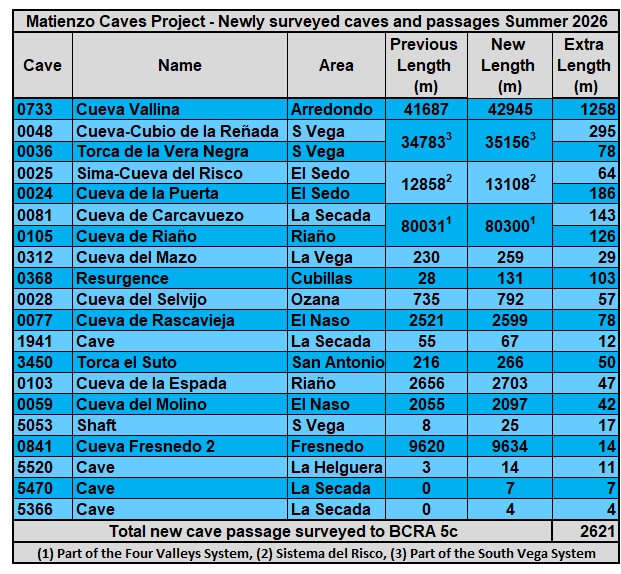
Elsewhere, no single major find was made, instead just under 1.4 kilometres were found and surveyed in 19 sites, much of this being in caves found in the early years of the MCP such as 186m in Cueva de la Puerta and 64m in the linked Sima-Cueva del Risco thus extending the Risco system by 250m to 13,108m. Seventeen new digs and caves were found and recorded. Some have been pushed but work (pushing, digging etc) for a number is still needed. In total one hundred sites were visited, and 189 trips were made during the expedition. Just over 3km passage was surveyed including needed resurveys. Of this length, 2621m were new surveyed passages.
S O U T H E R N S E C T O R
Arredondo
The main work in Cueva Vallina (0733) over the summer was in two areas. In Vallina II our Catalan colleagues continued their work climbing avens and pushing. They descended into Vallina II via Cueva La Rasa (5135) over two trips and broke through at the boulder choke to find about 716m of very large galleries (Galeria dels Somnis) above the New York Gallery with some passages over 40m wide and clearly very old. The second three-man 15-hour trip surveyed the area but the boulder choke contains two tight sections and the second was too tight for one member who had to wait for the work to be completed. With this reduction of the team the two through the choke decided to concentrate on surveying and leave serious pushing to a future trip.
A subsequent trip of 23 hours pushed on, adding another 531m to the high-level passage. This area is at the same altitude as the main passages in Torca de la Vera Negra (0036 Torca de la Cabaña) indicating that a more extensive system at this level should exist in and between these two cave systems. The new passage in Vallina II extends under the South Vega area and currently ends under the valley that contains sites 4600, and 5558, some 50m or so below the surface. Further prospecting up this valley area will be well worthwhile, and location using the SubPhone is also an option.
At the possible connection between Galeria de la Cisterna and the passage going south from Pantaloon Junction (the "G spot") considerable progress was made over 8 arduous digging trips. These were led by Jim Lister and a number of young cavers who worked very hard at this site to open up a route to the passage below. This is an important connection as, if it does connect, it would prove a less difficult route to get diving gear to Sump 6 and thus pursue the link to Cueva Reñada (0048). Work was hampered by a band of rock with calcite veins that proved hard to break up. This will be pursued in 2027 using better techniques.
Also, in this area of the cave a series of tight pitches and areas were opened up including the small rabbit sized hole and another hole named "Eye Squeeze" to a small, pretty chamber "PG Tips Chamber". LIDAR scans using the Apple Phone App were made in some of this new part. This area was surveyed including a pitch that was named "Odio a mi novio!". A final trip to recover kit was made by two members, with some kit was left in the cave for future work.
Other exploration was done in the top entrance area around Ha! Aven, where it was found a number of ropes were in place. However, hangers and bolts were showing signs of age: work is needed to replace some of the fixed gear so further climbing work can be undertaken. The team continue exploring the Resistance Gallery area and bolted a climb up above the p12 to get a look at a promising lead in the higher levels where four good bolts were placed until the good rock ran out. The lead is promising so the p12 rope has been left in situ, but the ropes on the traverse and p20 has been removed.
Climbs in the 6-ways chamber area were investigated. At the top of Zarco's Pitch, there is one good lead, but it is in poor rock and will be better approached with two people. At Swirl Chamber, a steep climb up to an aven that is visible in the ceiling is being climbed but again, it is in poor rock. Despite this, the project is ongoing.
Corkscrew Climb was examined to see if it was a viable route for a diver to get access to Canyon sump in Vallina I, but it proved to tight and awkward. On the way to Dangerous Chamber two eye holes were noted up the now named "Cowboy Aven". Access was gained by tying a bunch of hangers on the end of a thin line and throwing them towards the top hole. On the fourth attempt the hangers went through and swung back through the second hole. An SRT rope was pulled through and access gained. This and another nearby aven need climbing and are not far from the high-level passages that extend from the Ha! Aven area.
South Vega
Eight trips were made into Cueva-Cubio de la Reñada (0048), mainly to take diving gear to sump I and then for Mark Smith to dive the sump on the way to Reñada II and the Rub-a-Dub-Dubs sump. The state of the sumps was very unusual - they are normally very clear unlike the Comediante resurgence where it appears an inlet causes the water to be cloudy. However, on this occasion the water in Sump I was so cloudy the visibility was down to a metre at most. Another issue was that the diver's side mounted KISS rebreather was not functioning correctly - when Mark was looking up it produced bubbles. However, despite these handicaps, Mark dived the sumps and put some 140m onto the line that had been laid by Rupert Skorupka. The visibility did get better towards the end of the sump, possibly due to inlet water but not good enough to see all the sump walls or if there were any holes or way on in the roof. So, pursuing this key site further will be left to 2027.
On a trip to the Blood Alley area, 295m of previously unsurveyed passages were completed as part of the task to resurvey the bottom levels of the cave. In addition some familiarisation and photographic trips were made.
In Torca de Azpilicueta (0333), four Catalan cavers rigged and descended the cave and had no problems reaching Giga Hall. They used the existing tackle, but reported that it now needs re-equipping. At Rub-a-Dub-Dubs the handline that had helped people avoid dropping into the deep pools is now completely destroyed and the team decided to spend the time on this visit to repair those traverse lines. On the next trip, three of the Catalans decided to use pull-through and exit via Reñada and continued the work on repairing the Rub-a-Dub-Dubs lines, leaving only three pools to rig at a future visit. The team concluded "that the system has great potential and there is still a lot of work to be completed". The plan for future tips is to improve the rigging with some intermediate change overs so reducing waiting times. Going out of Reñada was considered not the best option with in and out of Azpilicueta better.
Elsewhere, 12 visits were made to various sites, the main one being to Torca de la Vera Negra (0036 Torca de la Cabaña). This cave has not been visited for many years but, with the large passage finds made in Vallina II at the same level, possible extensive open systems may exist at this altitude. The decision was taken to re-explore the cave and update the survey. Over three trips a team led by our USA members rigged the entrance serries noting a lot of old and rusting gear left from decades previously. Wiggle Passage was accessed and surveyed and found to have many fine formations. A number of leads were followed including to a chamber with a prominent red stalagmite. There are still leads to be followed needing rope access as well as completing the survey and pushing in the rest of the system. The team surveyed 160m of which 78m was new.
The strongly draughting shaft 4998 was visited on four occasions and excavated to a hole that was "distoed" at 5.2m but rocks seemed to fall further past a mud floored area. The access to this was opened up and the next drop was measured at 7.12m giving a total depth of over 12m. More work is needed to open up the tight sections to allow access down this pitch. The site is in a good location with no known parts of the South Vega system within 300m.
Site 5053 was worked on at Easter. This summer the block in the entrance was removed and it was found to be about 20m deep with an entrance pitch to a small chamber followed by a further pitch of 7m. Unfortunately, all leads closed down. Although digging could continue, it is thought to be a poor prospect.
The nearby shaft 4999 was found to have a good draught and both here and at the dig 0495 more accurate GPS readings were taken. Shaft 2564 could not be found at its GPS location.
Seldesuto
A trip to Torcón de la Calleja Rebollo (0258, Toad in the Hole) to climb a high aven was prevented by a large boulder blocking the entrance. On a subsequent trip to remove the obstruction (and then go into the cave) it as found to be much more difficult than expected. We were not keen on breaking up the rock as it was then likely to fall down and block the way on in an even more difficult section of the entrance pitch. Eventually the rock was removed using a wire hand winch and temporarily secured to the wall with a pully system. However, it was then found that further boulders blocked the way on further down the tight shaft. To remove this rock the entrance probably needs opening up a little and, to make the site safe, scaffolding and shoring is needed to stop further rocks falling in from the unstable steep entrance slope. The walk up to the cave was found to be arduous due to vegetation now that fewer cows are grazing the area. The problem is that this vegetation is hiding very uneven ground and hollows. Access at Easter with the shoring items may be a better option: it's likely to be cooler, with less undergrowth.
The shaft 2754 was found in 2012, was accessed from above, and is an 8m pitch to a chamber. A draughting lead in the floor on the side of the chamber was opened and it was possible to look into a large open space. This was pushed through into a new chamber 6m long, 4m wide and 10m high. There is still a draught and a few possible, not very promising digs. In the first chamber some fairly small boulders were removed and stones rattled down some distance.
Callejon de Seldesuto 2 (2741) was dug in its main chamber and got down some 2m through boulders to a clay floor. There is a small draught but the site is not very promising. Site 5559 was opened to the top of a rift with one small boulder preventing. After removal it was possible to get to the bottom. It could be dug further but there is no real draught. The depression 5568 was looked at but there was no sign of cave development. Sites 4000 and 1357 were looked for but not found. Torca de la Salamandra (0056) and site 1149 were confirmed at the GPS locations and photographs of entrances made.
North Vega, Cubija and El Naso
Torca Lastrilla (0427) was visited and some of the old bolts/hangers were replaced due to their poor condition. No new finds were made with leads on the big pitch route being poor.
The dig 0813 in Cubija (now called "High Hopes Hole") was a key target with 15 digging trips, each of which making progress at this strongly draughting site. A large number of younger members were introduced to a variety of digging techniques which we hope they will find good use for. Very good progress was made extending this dig (now a cave) down into open passage. However, on the last visit some rock moved and it was considered too risky to continue without some extensive shoring and scaffolding to make the work location safe. This will be a project for a future visit.
Torca del Mostajo (0071) was visited on four occasions mainly to check for leads below the entrance pitch to see if there was any development towards the 0813 dig - none was found. On a trip to check out some possible leads, one of the team fell on the first traverse onto the cow tails hitting her arm on the wall. The team turned back after a bit when it was realised the injury could be significant. At the Ramales Medical Centre and at Laredo Hospital it was diagnosed as a stable fracture resulting in a half cast. However, back in the UK it was found that it was not broken but was deep bruising. A photographic trip was also made to the Golden Void area and the site was derigged after some issues with jammed maillons.
Two trips into Cueva de Rascavieja (0077) were made to look at a rift near the present end of the cave near "Beauty and the Beast". It descended into the tall passage "Chamber of the Last Hope" and into new passage, but a rope hanging from above showed they were now below an undescended pitch. All ongoing routes were found to close down and there was no significant draught. The team also looked at an unexplored hole in the ceiling at Antler Chamber near the entrance. Going through a squeeze at the top of the climb met a new chamber, "Moose is Loose Chamber". This chamber is finely decorated with large helictites, pristine floors, and a large central stalactite. It has a climb at the far end which did not seem to go anywhere. On a second trip this new find was surveyed.
At the well-positioned and strongly draughting Palindrome Dig (0535), an assessment showed the unstable boulder choke would take days and a lot of engineering work to proceed safety. It was agreed other sites in our area are better prospects for such work.
Cueva de Molino (0059) was visited with some of the team's children on a sporting trip. A second team explored Rio Tuerto inlet and pushed and surveyed 42m in a draughting side passage.
Elsewhere on El Naso, the site 4195 was found to be rocks at the bottom of a shakehole with no draught and little prospects. The site 4196 looked more interesting and a couple of hours were spent pulling rocks out to open a rift 30cm wide blocked by rocks. The dig had little or no draught on a cool day and so needs checking on a hot day.
El Sedo, Ozana and La Colina
The main work here was in Cueva de la Puerta (0024) that now links into the Sistema del Risco (0025). The pitch was descended at the end of a passage that continues over the traverse that links into the end of Risco's Tonto Series. The pitch was climbed with a hand line to a second pitch which cuts back under the passage but needs opening to get further. The area was surveyed as well as looking at a climb in the roof that leads to an aven - this requires a bit more protection to climb. It looks like it may end but it is not possible to see a small area about half way up and needs another visit. A small but passable crawl was followed for 20 to 30m until it entered a bigger area with stal where it was found that the highest route was best and it reached mainly easy crawling in a rift passage to a stal squeeze. Once past this it was possible to walk to a corner where a high and blind rift comes in. There are some leads left to push, a hole in the floor requiring digging with a lead off to one side and a calcite run-in that blocks the lower section. This has a good draught and needs more work to progress. The new areas were surveyed bringing the system length to over 13km. A sporting through-trip between Puerta and Risco was made after one attempt failed due to not finding the right connection.
In Risco, three photographic and sporting trips were made as well as a trip to survey and tie-in the new pitch from Upper Arco to Arco Passage explored last year. All was successfully carried out and 64m was added to the survey.
At Cueva de Tiva (0026) a trip was made using a maypole to climb to a higher passage. This started out walking size but very quickly became a crawl after about 10m. After reaching a corner, a small boulder forced a squeeze into new cave and a very small chamber. The continuation of the passage reached a large flake blocking the way, but it does not look promising. The estimate of new passage is 12m. Below, some digging took place in the mud floor. There are signs of the passage continuing but the site again does not look very promising.
At Ozana, in Cueva del Selvijo (0028) work continued surveying 57m of new passage leading on from the passages explored at Easter. This was in dry routes on the left at the end of crawl, from a 4-ways 'crossroad' junction. The cave continued through a muddy passage with some loose boulders, ultimately connecting with another branch. Downstream became too small.
A photographic and tourist trip was made into Cueva de Jivero 2 (0017).
Two new sites were found when trying to locate Torca de la Musquia (0022): #5573 - a short 2m tiny cave with no real prospect, and #5574 - a 5m diameter and 12m deep vegetated depression / shaft that awaits exploration.
In the hum at the entrance to La Vega there should be a small system linking a number of caves. Four trips worked on this project. At Cueva del Mazo (0312) the cave was visited for the first time since 1982, and was re-surveyed with 29m being added. The team found the entrance tight and needed opening up. They progressed through the stream cave to the final very tight part where a cairn was left. The resurgence cave for this small system (#0368) was visited twice and was resurveyed and excavated to allow all to get through the smaller sections to reach where the passage improved in size. There are one or two sections walking for a couple of metres. It remained a narrow thrutch upstream until things lowered to a dig that was opened to a damp crawl as far as another narrowing that needs more work. On a following trip, handy tools were used to forge forward slowly, over calcite dams, the explorers enduring water surges each time. After surveying an additional approximate 30 m, they reached a more substantial calcited region which became very small. In total the cave was extended from 28m to 131m. At Cueva de Casa Blanca (1808) on the Hum, the team moved one boulder in trying to re-open the hole but the cave now requires a further visit with a bolting kit to remove another rock.
On La Colina, four new sites were identified (5563-5566) and photographed to avoid duplicate work in the future. None were more than 2m deep and did not have much prospect. Only a depression (5563) needs a further look in the thick vegetation to check for possible digs etc. Cave 0271 had its GPS location corrected.
N O R T H - E A S T S E C T O R I N C L U D I N G T H E F O U R V A L L E Y S S Y S T E M
La Secada
Twenty sites were visited over some 39 trips. At Cueva de Carcavuezo (0081) five trips were made to look at a number of possible leads. At the junction just before Afternoon Stroll question marks on the survey were looked at. One led for about 5-10m to a pocket with an alcove on the left and is a potential dig site. Another lead went to a small sloping chamber and then via crawl to another sloped chamber. Here a difficult climb leads to the end of the passage in a small choke. Right in the chamber leads back to near the Boy's Entrance. This complex area of small linked chambers and alcoves was surveyed over two trips with a total of new cave at 143m. While surveying, Tiff's dig and some other sites were briefly dug, but no real progress has so far been made. On another trip to check for leads in the Big Chamber Near the Entrance, the bottom and top of the climb into the chamber was found to be loose and with little solid rock. It was decided not to proceed – a rope on the climb would be useful and help avoid the loose rock.
Above Carcavuezo, at dig 4016 a large boulder was removed, but only to show more rocks. So no easy access - but there is still a good, cold draught.
Two trips were made to Torca la Decepción (4732). The first was to rig the cave and take a few photos of the streamway and to find the way through the Armageddon chokes. This was followed by a through-trip to Giant Panda entrance (2691) as research for a publication on the Four Valleys System. This was the trip where the accident at Armageddon happened (see the introduction).
Dig 5567 was identified above the end of Aven Passage in Torca la Decepción. It is a hand size hole with a draught! The team dug out soil and rocks to a rift 15cm wide which was opened up to allow access and to confirm that it remained small and tight, requiring further work to continue. Site 4131 is in a location that suggests it may link to the Trident Series. It was visited to check digging potential and what gear would be needed. It was found to be cool in the dig with a small out draught. The team dug out spoil but it now seems to have a solid floor at the end. It is now an easy rock removing project needing appropriate gear.
Cave 1941 was checked out and re-surveyed with 12m of this being new passage. Also checked for correct GPS and entrance photograph was shaft 0871. Shaft 1279 was descended after removing many brambles to find it was only 6m deep with few prospects.
A number of other sites were visited including Two-way Cave (4534) which was first thought to be new and was dug a little with no success. Shaft 5533 was worked on at two spots, removing rocks from the choked shaft with no sign it will open up, and at the end (going into the hill) boulders and fill were removed but no open passage found. There is little or no draught but the air is cold. At dig 5470, the lower dig was opened up and large blocks removed to allow tight access to an uninspiring space about 2m diameter. A small amount of clearance was carried out in the hading rift to allow exploration to the end.
Dig 5569 is a 1.2m-deep hole above Ladies Pot (0513) that turns to the south and closes down with no draught. Shaft 5572 is 5m deep but covered with a rock flake which will need a rope and more people to remove. Site 5530 was plumbed to 6m deep, not 3m as in the site description. This is probably worth another look as it is quite open below the surface. Also looked at was shaft 5366, but this was only 4m deep. Dig 5379 was visited and a photograph of the entrance taken.
At Cueva las Cosas (0084) a lead spotted in 2025 in the boulder choke on the left of the main chamber was climbed via a squeeze into a small void and then to a small hole which was opened up to a small chamber with no way on. A dig at floor level filled with calcited rock was dug, but it only went 2m to where is closed down.
The strongly draughting dig Cueva Superfosfato (0200) was dug on two occasions. About 250 buckets of surface muck and claggy clay and cobbles were removed which seem to have been washed in since Christmas. This is a major, long-term excavation project with a strong cool draught coming from the floor.
Also worked on was Socks (1017) on one occasion, and Pants (1655) on two visits where some progress was made. Again, these are major projects with strong draughts.
Site 1293 was checked using a camera past a narrow rift at roof height to what looks like an open passage. Work will be required to open this up.
Coterón las Llanas
Near Matienzo's northwestern ridge, two new sites were recorded. First, a shaft 5570 which is by the road from the substation before it drops past the farmhouse to La Gatuna. This walled shaft was uncovered and descended to a choke, needing a further check out for digging prospects and if any draught (likely to be an in-draught at this altitude) in warm/hot weather. Also found was a dig at a water sink (5571). This is in a large depression above the road with water sinking (in damper conditions) at the base of a 4m-high cliff. This should make an excellent dig with easy access!
Also checked out were overgrown shafts 4806 and 4807 - both have old barbed wire fencing and appear to choke 2m down. Shaft 1280 could not be found at the GPS location and, after 3 hours of removing the undergrowth at shaft 5326, a team member was able to descend and hit a dead end after 10m.
Riaño
At Cueva de Riaño (0105) work was carried over three trips including in the Pendant Chamber area where, at a high-level passage, a traverse was bolted that extended over the lower passage area to a pitch (Spousal Murder) that proved to be 6m of a horrible squeeze and to a further 5m very tight pitch with sharp walls - this pitch was considered the worst the team had done and was not to be repeated! A second pitch off to the right from the end of the traverse led to about 125m of open, stomping canyon to a loose 5m pitch where dropped rocks sounded like hitting water. The passage seemed to continue over the pitch.
On the next trip the 5m pitch was dropped and was a very tight slope to a sharp rift passage, but with a further drop close to the base of the first pitch. The bottom of this pitch could not be seen but was estimated as between 10m and 20m. The rift was followed to a 20m wet aven with a possible side passage near the top. This aven forms another hole in the canyon floor which the team then started to bolt across to another hole in the floor of the canyon, after crossing the aven hole. All ropes were left rigged for a future pushing trip but there is no survey due to technical difficulties with the SAP6.
At Cueva Hoyuca (0107) five trips were made mainly for familiarisation as part of a project to produce a substantial monograph on the Four Valleys System. The team were mainly looking at the area prior to the Gorilla Walk and did find the Punk in the Gutter passage wet, cold and too tight – just like older members of the expedition remember having to lie in water while digging it out! On three trips, Giant Panda (2691) entrance was rigged in preparation for a through-trip as part of the monograph project. Some damaged ropes were replaced on the second pitch and some additional aids placed on the first pitch which were later derigged.
At Cueva de la Espada (0103), over four trips, the main chamber area was visited to look at leads and into an area with nice formations with a further small chamber. In the main chamber, a climb up a calcite slab and squeeze reached calcite formations, animal bones, and tree roots hanging from the ceiling. The team then spent two trips to climb a route to link into site 3442 with the aid of an aluminium ladder. The exit to the surface was silted up with hard mud and needs excavating.The area was surveyed of which 47m was new. The ladder was used to check other leads including a 4m climb near the top river entrance. A tight section was opened up to a 1m climb down to a 2m dia blind pot. Several other leads were noted that all need work to remove rock to enter. On the final trip, the tight section up a calcite slope was opened up just to connect with another dig that had been previously noted.
The cave / dig 1801 sits between Cueva de la Espada and Fridge Door Cave (1800). This was visited on four occasions. Some progress was made but, after moving spoil and rocks and then moving a larger blocking rock, it was found more boulders block the way. So, it is becoming a significant dig.
At Sub-Phone Entrance (4536) two trips were made to work on Hidden Crawl that is below Ali Chamber. It was found that the blocking rocks needed breaking up and this was done. On the next visit some mud was dug out to allow access through the squeeze without a helmet. Beyond was standing height and a climb up into a 1m wide tube, with passages that either choked or were too small.
The team then went into Mitre Passage to look at leads from 2016. A 30kg rock was removed opening a 2m climb down into a small passage. This passage continues up an enlarged squeeze towards the NW. The passage turns and heads E as a wide crawl for about 20m. The way on is a 1-1.5m wide climb up in a tube that may free climb and may go into Upper Mitre Passage level. But there is no question-marked leads around there in the Upper Mitre Passage.
At Boob Tube (5000) a derigging trip for gear left before #5000 was excavated was made through to Cueva Llanío (3234). All went to plan until, at the Cueva Llanío entrance, the team found themselves in the middle of a large 2m high bramble jungle, with no easy way out. Eventually a heavy tackle bag was used to push the jungle down enough to work through the brambles and to escape.
High above Boob Tube the dig 3302 was checked out. It consists of four holes under an undercut. The second from the left, had the best - but only a very small - draught. The hole just above this was also looked at. It was decided it would take a lot of digging and with only a small draught it is not worthwhile.
Secadura
The sink 3221 that could be a feeder for Gour Inlet in Cueva Hoyuca (0107) was checked out to see if it could be dug to link into the system and, if so, an application on our 2027 permit may be made. The stream was found to be sinking higher than the GPS location. Cattle have trampled the ground and there is no sign of a sink at the GPS location. In wet weather water seems to continue on the surface down the slope towards the woods. A surface check in wet weather should be made to confirm if there are any prospects.
Fresnedo
Cueva Fresnedo II (0841) was visited on three occasions to continue the bolting lead at Pepe le Puits. Progress was made on the first trip to reach the target passage but a second trip had some navigation issues as they had only been into the cave once before. (The survey is not complete with centre lines in a number of parts with no detail). A third trip completed the traverse to reach the muddy passage on the other end. Only 14m was found after all the hard work. The traverse line was derigged at the end but the pitch up is still in place. This cave now needs a thorough check for leads and, critically, the survey needs completing.
The shaft 2415 is situated on the right of the road from Matienzo to Solórzano just next to the Fresnedo caves turning. The entrance had become blocked due to road and forestry work. A strong team tasked with improving the survey drawing and checking for leads had first to open up the over-grown and debris-filled entrance. The team found a bolt in good condition at the top of the 16m entrance pitch. About 2m down there was a blockage with lots of loose rock, wooden planks and a bone. These were moved further down the cave, revealing a few more metres descent into a small chamber halfway down the entrance pitch. The team planned to rig the next part on ladder using in-place bolts as the description suggested. However, the only spit was rusty and not useable. The ladders were rigged off naturals but were 2m short, so a second trip was made with bolting gear. These reached the bottom of the entrance pitch and the team checked all possible leads. Overall, the cave is very 'choss'. The only leads potentially worth returning to would be the small draught at the boulder choke found through a hole in the floor where the left hand climb up is shown on the survey. It would be worth re-bolting the second half of the entrance pitch so the rest of the cave can be explored further. Throughout the cave there are lots of loose large rocks - so take care!
N O R T H W E S T S E C T O R
San Antonio
Torca el Suto (3450) was visited on two trips. Access required 20 minutes jungle-bashing and the entrance pitch was re-bolted. The traverse in the Left Hand (West) Series at the head of the 15m + 34m pitch, was tackled using a mix of bolts and naturals to reach the far side of the pitch but the team then ran out of rope. To improve the traverse line a bolt was placed to make the middle section safe. As the hole was drilled and leaning on the largest of the flakes, it broke loose, coming to a rest at the bottom of the shaft thus rendering the already sketchy traverse quite unsafe. More bolts were placed and with some re-tensioning. The next visit finished the traverse, only to be faced with a second hole a few metres further on. The rest of the team surveyed while this was bolted over. Unfortunately, a little further on, the big rift passage ended in a boulder choke. The 12m Rhubarb Crumble pitch was dropped to a loose rift and a further 3.5m drop into the final Gas Chamber. Fifty metres were surveyed but no good leads were found.
Elsewhere in San Antonio two sites were checked. A trip was made to find a cave that John Southworth had entered when he first came to Matienzo. We knew it was in the field that contains 3082, but the likely location was found to be now covered in large bramble bushes, so no joy. Dig 3082 is not worth any effort as there is not a real hole, no draught and no prospect! At the top of the same field cave 3083 was easily found at the GPS point and is a hole under a boulder with a gap in the floor dropping a short distance, but there is no echo or draught. It could be dug but it is a poor prospect.
N O R T H E R N S E C T O R
La Helguera
Two sites in this area to the west of Solórzano were visited. A resurgence 5519 was found to be draughting 2m down from a passage running north-south. The northern passage closes down after 1.5m; the southern one is draughting and about 2m long but would require a lot of digging. In the floor, through a gap between boulders, a passage floor can be seen, but a lot of effort is needed to gain entry.
In the same area, the cave 5520 was found to have a strong draught so two digging trips followed. The first opened up and dug out the entrance and found ongoing open passage. The following trip started with much expectations of a massive find. Despite the expectation and hype of finding miles of new cave the site only gave up 14m! All leads ended or choked. However, it did provide an excellent opportunity for one of our young members to carry out electronic surveying then same-day drawing up using Inkscape with the Survex and svg files. (#5520 survey)
O T H E R E X P E D I T I O N A C T I V I T I E S
San Miguel
On a drive round the area, the Nacimiento del Río Clarín (0115) had no apparent flow, showing how dry the summer had been. Later, as part of the debate over wind turbines and storage batteries in the San Miguel, Ogarrio and Matienzo areas, a television programme interviewed a number of local residents and also Juan and Peter Smith at the entrance to this resurgence. The interview for 11 TV (a station for the eastern side of Cantabria) was about the issue of such development in karst areas and the damage they can cause. The work of the Matienzo Caves Project was also discussed.
Summer Expedition report by Phil Papard, 3rd September 2026
O T H E R N E W S & A C T I V I T I E S
Bill Nix and Emma Key, on breaks from the Wessex Cave Club's organised caving out of Ogarrio, photographed Marvin's Marvel in Torca de Coterón (0264) and formations in Simas del Picón (0075).
Early in September, Guy Simonnot reported work in two sites in Ogarrio. Cuvía de Lolo (#5504) was pushed in tight passage to about 100m length; shaft 5153 below Cueva Collusa (0003), first documented by Pete Smith, was explored down a p14 to a steep, beautifully decorated slope down to -45m where exploration stopped for lack of rope. It's unclear if exploration continues, but the site has been named Torca de la Liana.
Earlier in the year, Carmen Ruiz, Hoznayo resident and author / researcher into the spa complex around the Fuente del Francés (4171) and the Injanas caves, exchanged information about those sites and others in the area. The details can be found at the start of the summer 2026 logbook.
Helen Sergeant
Matienzo cavers will be saddened to learn of the death of Helen Sergeant, wife to Jim Davis and mother to the "tres niños", Benjamin, William and Samuel. She passed away shortly after the end of the summer expedition on August 25th.
Helen was a well-known and respected member of the University of Leeds SA and the Red Rose CPC. Prior to Matienzo she engaged with several caving expeditions to Greece, Mallorca, Yugoslavia, Asturias and Guyana. Her first visit with Jim to Matienzo was in 1977 and by 1988 all three children were being shown the delights of Matienzo caves. Apart from being good company, it has to be said that, although Helen did some caving, her other significant contribution to Matienzo caving was looking after Jim and the three boys - no mean feat on the old, muddy, drippy campsite!
Her last visit was in the summer of 1999, although Jim and Sam have been regular, recent participants in the expeditions.
Helen's funeral was at St Oswald's Church, Horton-in-Ribblesdale, on 11th September.
RIP
| New surveys and survey updates to come | |||
|---|---|---|---|
| Description | Drawn survey | Survex centre line | |
| 0024 | Cueva de la Puerta | in hand (PS) | 0024 |
| 0025 | Risco | in hand (PS) | 0025 |
| 0028 | Selvijo | complete (JC) | 0028 |
| 0036 | Vera Negra (Cabaña) | interim (JC) | 0036 |
| 0048 | Reñada | in hand (PP) | 0048 |
| 0059 | Molino | needs complete resurvey? | 0059 |
| 0077 | Rascavieja | complete to Easter (GN) | 0077 |
| 0081 | Carcavuezo | 4VS in hand (PF) | 0081 |
| 0103 | Espada + | complete to Easter (JC) | 0103 |
| 0105 | Riaño | 4VS in hand (PF) | 0105 |
| 0312 | Mazo | prelim (JC) | 0312 |
| 0368 | resurgence | complete (JC) | 0368 |
| 0733 | Vallina | complete (JC) | 0733 |
| 0841 | Fresnedo II | complete (JC) | 0841 |
| 1941 | cave | in hand (MT) | 1941 |
| 3450 | Torca el Suto | complete (JC) | 3450 |
| 5053 | shaft | complete (JC) | 5053 |
| 5366 | cave / dig | complete (JC) | 5366 |
| 5470 | cave | complete (JC) | 5470 |
| 5520 | cave | complete (DT) | 5520 |
The list below shows links to those 123 sites which were extended or newly discovered around the summer 2026 period, or which have had surveys, references or descriptions updated, photos or movie clips added, or entrances repositioned using a GPS.
Arredondo 0733 Vallina, Cueva;
Barrio de Carrales 5573 cave;
5574 shaft;
Cobadal 0919 cave;
Coterón las Llanas 4806 shaft;
4807 shaft;
5570 shaft;
5571 dig;
Cruz Llorada 1280 shaft;
5326 shaft;
Cubija 0071 Mostajo, Torca del;
0075 Picón, Simas del;
0813 dig;
0814 shaft;
0892 Regaton, Torca del;
Cubillas 0026 Tiva, Cueva de;
0368 resurgence;
El Naso 0059 Molino, Cueva del;
0077 Rascavieja, Cueva de;
0535 Palindrome Dig;
4195 hole;
4196 hole;
El Rincón 5466 depression;
El Sedo 0024 Puerta, Cueva de la;
0025 Risco, Sima-Cueva del;
Fresnedo 0841 Fresnedo 2, Cueva;
2415 shaft;
Fuente las Varas 5509 shaft;
Hoznayo 4001 Injanas, Cueva de las;
4017 Hoya, Pozo de la;
4042 Riocueva, Cueva;
4074 Sixto, La Gruta de;
4171 Fuente del Francés, Cueva de la;
4244 Diablo, Gruta del;
4444 Injanas 2, Cueva de las;
4970 Picardos, Los;
La Colina 0271 cave;
1377 shaft;
5576 Fern Gully;
La Helguera 5519 resurgence;
5520 cave;
La Secada 0081 Carcavuezo, Cueva de;
0084 Cosas, Cueva las;
0111 shaft;
0200 Superfosfato, Cueva;
0260 shaft;
0511 dig;
0871 shaft;
1279 shaft;
1293 cave;
1655 dig;
1941 cave / collapse?;
4016 dig;
4131 dig;
4534 Two-way Cave;
4732 Decepción, Torca la (bottom entrance);
5366 dig;
5379 dig;
5470 cave;
5508 cave / dig;
5513 cave;
5530 shaft;
5533 shaft (dig);
5562 shaft (kiln?);
5563 depression;
5564 depression;
5565 hole;
5566 hole;
5567 dig;
5569 hole;
5572 shaft;
5575 hole;
La Vega 0312 Mazo, Cueva del;
N Vega 0427 Lastrilla, Torca de;
Ogarrio 5152 Liana, Torca de la;
5504 Lolo, Cuvío de (SCD 3799);
Ozana 0017 Jivero 2, Cueva de (top entrance);
0028 Selvijo, Cueva del;
1808 Casa Blanca, Cueva de;
Quebraduras 5411 shafts (2);
Riaño 0103 Espada, Cueva de la;
0105 Riaño, Cueva de;
0107 Hoyuca, Cueva;
1801 cave;
2691 Giant Panda entrance;
3234 Llanío, Cueva-Cubío del;
3302 cave;
3442 cave;
5000 Boob Tube;
S Vega 0036 Vera Negra, Torca de la;
0039 Coquisera, Cueva de;
0048 Reñada, Cueva-Cubío de la;
0264 Coterón, Torca del;
0333 Azpilicueta, Torca de;
0369 cave;
0495 dig;
1521 shaft;
1657 shaft;
2564 shaft;
4998 shaft;
4999 shaft;
5052 Manga, Torca de la;
5053 shaft;
5568 dig;
San Antonio 3082 dig;
3083 cave;
3450 El Suto, Torca;
San Miguel 0115 Nacimiento del Rio Clarin;
Secadura 0117 Boyones, Los;
3221 sink;
Seldesuto 0035 Arenal, Cueva del;
0056 Salamandra, Torca de la;
0258 Calleja Rebollo, Torcón de la;
1149 Oh no, I've Ordered a Heineken;
1357 dig;
2741 Callejón de Seldesuto 2;
2754 shaft;
4600 dig;
5330 shaft;
5558 cave;
5559 shaft;
5560 resurgence;
5561 resurgence;
Autumn 2026
AUTUMN report to come: link to basic data files : 2024 and 2025 Vallina reports : letter in El Diario : Demo : Bug collecting 2027 : Jan - October report : Harry Long's Field Notes
The list below shows links to those 46 sites which were extended or newly discovered around the autumn 2026 period, or which have had surveys, references or descriptions updated, photos or movies added, or entrances repositioned using a GPS.
Arredondo 0733 Vallina, Cueva;
Barrio de Carrales 5574 shaft;
5583 cave;
Coterón las Llanas 5571 dig;
5586 dig;
El Sedo 0015 Refugio de la Guerra;
0024 Puerta, Cueva de la;
0025 Risco, Sima-Cueva del;
Fresnedo 2414 Regolfo, Cueva;
2976 shaft;
2977 shaft;
5461 cave (original);
Hornedo 3738 shaft;
La Secada 0081 Carcavuezo, Cueva de;
0252 Decepción, Torca la (top entrance);
4732 Decepción, Torca la (bottom entrance);
La Vega 0312 Mazo, Cueva del;
5579 sink;
5580 sink;
5581 cave;
5582 resurgence;
Ogarrio 5516 Costal, Cueva del;
Ozana 0019 Loca 1, Cueva de la;
0022 Musquia, Torca de la;
0028 Selvijo, Cueva del;
0030 Tali 1, Cueva de;
5577 Tyre Hole;
Riaño 0103 Espada, Cueva de la;
0107 Hoyuca, Cueva;
5000 Boob Tube;
S Vega 0369 cave;
San Antonio 0713 Aguanaz, Fuente (top entrance);
San Miguel 0115 Nacimiento del Rio Clarin;
Secadura 0117 Boyones, Los;
Seldesuto 0044 Hoyo de las Puchas, Sima de;
0258 Calleja Rebollo, Torcón de la;
0580 shaft;
1116 cave;
1118 resurgence;
1298 dig;
5558 cave;
5560 resurgence;
5561 resurgence;
5578 shaft;
5584 shaft;
5585 hole;