Harry Long (1940 - 2026)
An Appreciation of his time in and around Matienzo
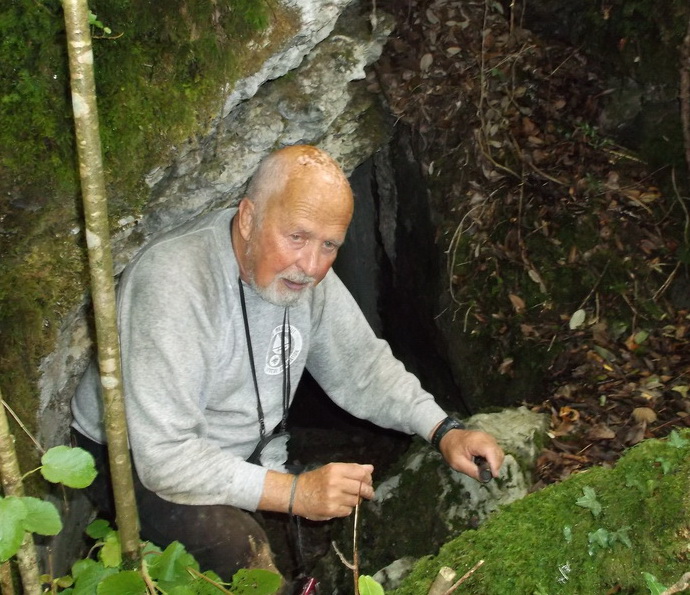
Harry at site 4183. Photo: John Clarke
He arrived with extensive caving experience already behind him: finding and exploring new holes in the Dales - Out Sleets Beck Pot and Pasture Gill Pot among others - serving as an underground and surface controller for UWFRA, and co-authoring the Northern Caves guidebooks.
He put these skills to immediate use in Matienzo. Unlike his English cave discoveries, where he often kept digs and finds close to his chest, in Matienzo he was consistently open about what he found. He was assiduous in writing up the public logbooks, drawing sketches and uploading photographs, and he regularly encouraged others to continue pushing the holes he had located. He often offered opinions on the geomorphology of the area and was particularly drawn to searching for entrances, possibly former resurgences, at past water tables, using the altitudes of major cave passages as a guide.
Wherever he went to scour an area for interesting holes, you could be sure he would leave no stone unturned and hole unpoked, and he nearly always came back with results. After finding something promising, he would then persuade whoever would listen to accompany him the following day to open up the entrance and explore - it didn't take much persuasion. Locals would often point him towards sites too: prospecting in Cobadal, after finding the deep hole at site 3829, a Portuguese man showed him another exciting opening, site 3830.
One of his most significant finds came in April 2009 in Riaño. Lank recalls taking Harry to a well-trodden area above the Cueva de Riaño sump and showing him all the holes he knew about, after which Harry asked what was up a side valley. A rather tired Lank mumbled, "Not much".
Harry returned the following day and crawled into a shelter for sheep, finding a blocked, low draughting passage. As his usual team was not around, he invited me to accompany him the next day as the first explorers. Even though he had been in many similar situations in England and Spain, his excitement was obvious as he carefully worked through the entrance crawl and climb down into eventually walking passage. Over a couple of days and a couple of hundred metres, he reached a hands-and-knees crawl and decided to leave the open, going passage for another time and more people. In the summer, Harry was a member of the pushing teams as they extended the system. In 2019, the now 7.3km-long cave - Cueva Llanío - was linked into the Four Valleys System. As Lank put it, "So much for 'not much'".
Further Riaño finds with Lank included Trackside Cave and Letterbox Cave, short but interesting fragments. In 2010, Harry and John Clarke, after asking permission to roam land above Cueva Llanío, were told of a "cold store" which turned out to be a 27m-long passage to a pitch. On a later solo walk, Harry was pointed towards sites 3457, 3458 and 2783. He spread the news and returned the next day with three cavers to work on the entrances, though without success on that occasion. Further work by Harry and John in the same area saw site 3442 connected to Cueva Espada. The pair were also active on the surface when the Cueva de Riaño resurgence was being dived, using the surveyed centre line as a guide to investigate sites 3662 and 1809. Walking above new passages in Cueva de Riaño with Paul Gelling, Harry found site 2638, later involving himself in the surveying and mapping a length of 205m.
He was keen to investigate overlooked places. He examined the sides of the Llueva road and catalogued sites 1981 - 1990. At El Suto, near Riaño, he documented shaft 3386 and the twin risings at site 3387. At Easter 2012, on a solo walk, he documented four sites including 3691 in the Llueva jungle, described as "a big walk-in entrance". This attracted attention and was eventually pushed to about 90m. He was less successful a year later with four holes documented on the southern slopes of the Llueva valley, though site 3833 was described as having the draught coming from "all over".
Alone and with others, Harry enjoyed investigating sites possibly associated with the Four Valleys System: sites 1666 and 1667 - obscure resurgences with the water sinking into site 1618; site 1496, which he worked at solo; and sites 1787, 1788 and 1789, choked stream sinks. His solo find of site 2685 above the 3rd River Inlet in Cueva Hoyuca (Uzueka) was pushed as Prophet's Cave to a length of 97m.
Paul 'Footleg' Fretwell remembers "... many conversations in the bar discussing potential underground and learning where Harry had been surface prospecting above the areas we were pushing into underground. It always felt like a collaboration where we were doing the multi-hour trips in the far reaches of the system and Harry was finding new sites on the surface based on the intelligence we gathered from our freshly entered survey data in the bar from the day before. He always seemed to have a knack of finding entrances we had just missed on our own surface prospecting trips as well!"
Harry also teamed up regularly with John Clarke and Chris Smith, cavers who could push the more constricted and awkward finds. The three were in action at the Fox Hat in Secadura investigating a possible dig, and in Carcass Cave in the Torno area. Nearby, they excavated a larger find: initially a draughting hole, the entrance was dug out to reveal a 6m pitch, and the cave was explored as Cueva de Huerto Rey, eventually reaching 666m in length with a depth of 33m. Harry later investigated the area over the presumed resurgence for the cave, noting sites 2760 - 2765 and, higher up the hill, cataloguing sites 3512 and 3513 - the latter remains unexplored. Other successes with John and Chris were documented in Fresnedo in 2007: Slaves' Cave, Coercion Cave and Freedom Pot. John and Chris understood their roles 'under' Harry as the Prophet!
At Easter 2011, Harry was prospecting with Dave Milner around La Gatuna, finding three sites of interest. He also took Dave to Fresnedo where Dave was able to extend the confusing Fresnedo 1 cave by 44m. In the summer of 2011, Harry, John and John Southworth found and worked at draughting site 3451 and sites 3555 and 3556. The first of these was later pushed into a tight 144m-long system with ongoing possibilities, particularly as a potential inlet to Fridge Door Cave. During surface explorations in Secadura, Harry and Dave also found sites 3520, 3521 and 3522.
There was hardly an area Harry didn't get into, and he was always up for the big digs: opening up the Sumidero de Cobadal was one example. Prospecting nearby with Dave, he found site 2066 - The Sewer - a strongly draughting, constricted, wet site ending in boulders; at a later date he documented sites 2774 - 2779. The discovery of Torca la Vaca at San Antonio prompted searches of the hillsides and valleys above, and Harry was one of many to get involved: site 3014 was one success, and site 3923 required three days of excavating and exploring a mucky chambers-and-pits cave.
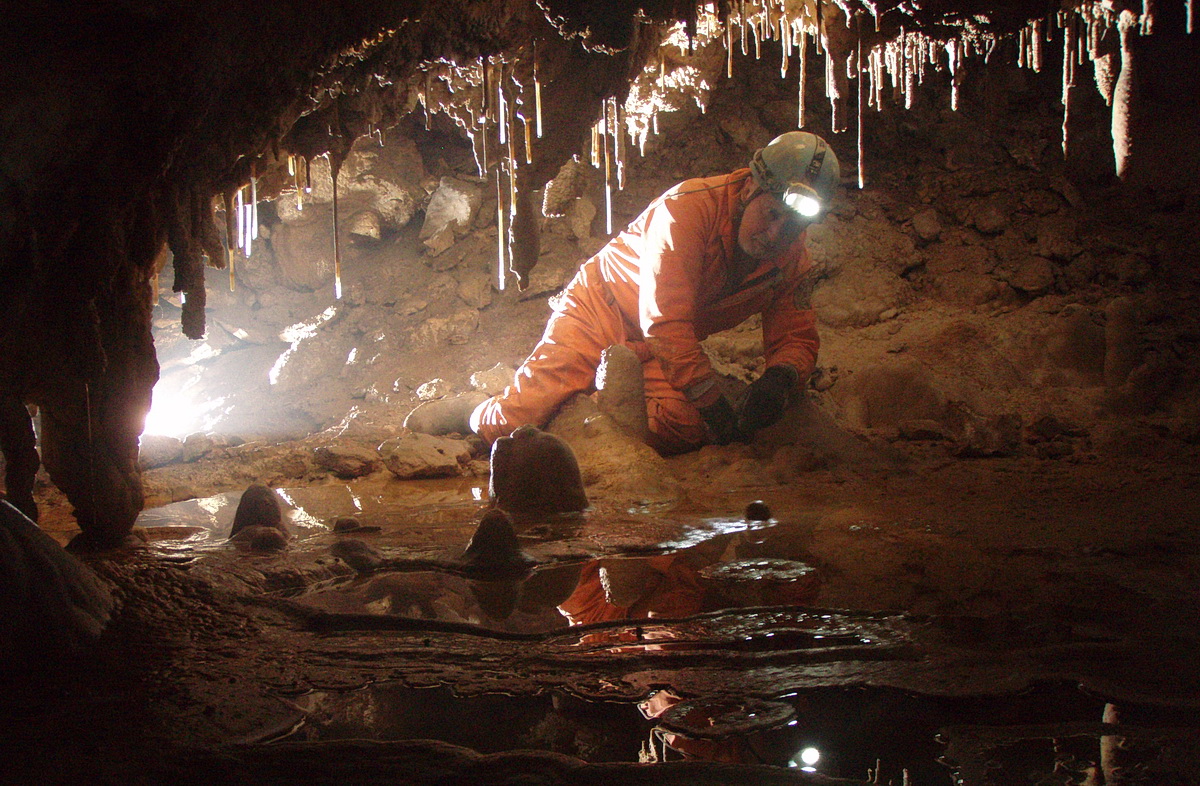
Harry in site 3355. Photo: Juan Corrin
It is not possible to mention all of Harry's finds here, and some of his documented sites have yet to be revisited and properly checked out. His enthusiasm, detailed knowledge and experience, and willingness to share what he found - in the logbooks and with fellow cavers - made him a real asset to every expedition he joined. Outside of expedition times he was checking descriptions and reading up for future prospects.
He has had, and will continue to have, a lasting influence on the going leads and cave passages documented around Matienzo.
RIP Harry.
Juan Corrin, June 2026