Roof Breakdown in Cueva Hoyuca
Introduction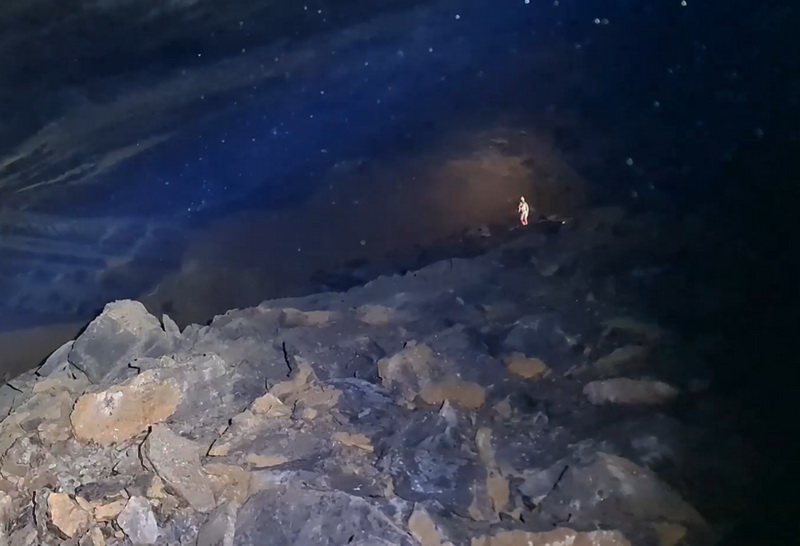
Some of the videos in the Trident Passages and el Gordo in Cueva Hoyuca (taken recently by Simon Cornhill and Diane Arthurs) show a gentle rain of particles from above when the space is illuminated from the side with a strong light. (This is known as the Tyndall effect). Some of these particles could be dust off caving suits, but the videos show bright particles falling slowly from a height - unlikely to be suit debris, more likely to be material from the roof.
Starting at 20 seconds in, the next 30 seconds of this video from el Gordo illustrates the effect. A screen-shot of the particles is shown on the right.
El Gordo is a huge breakdown chamber, about 130m long by 80m wide with a roof up to 50m above. Large blocks (mainly limestone?) litter the floor, evidence of massive roof collapse - quite possibly, fairly recently.
The steady, gentle rain of material raises a number of questions:
• Why are the particles in the air? and what are they?
• Is it a sign of imminent collapse?
• Could the particle fall be measured?
• Could the particles be used as a draught indicator?
• Are there any health implications?
Questions (prompts) were put to the Anthropic's AI assistant Claude (Sonnet 4.5) over a couple of hours within a developing "conversation".
Answers and information from Claude Sonnet 4.5
The usual caveats should be applied to all of the information presented below. Some of the prompts are or could be misleading and the answers could be plain wrong!
However, on a casual read through, the answers and information presented give, at least, plausible processes, experiments and implications. There is "food for thought" and, possibly, stimuli for future experiments, not necessarily in el Gordo.
PROMPTS
In a very large cave chamber with a sandstone roof (50m above any cavers) in Cantabria, there appears to be a fine "rain" of particles which show up when the space is lit from certain angles. What could the particles be and what mechanism is causing this "precipitation"? Give some deep thought to this: sandstone composition, spalling, drying out, etc, etc.
The chamber has been entered recently, but no enlargement of any entry route was required. The floor of the chamber is a jumble of sandstone blocks (some looking very recent) which have fallen from the roof.
RESPONSES
PROMPT
The old roof and now the blocks on the floor are more likely to be a mixture of limestone and sandstone, initially forming the beds in the roof of the chamber. Modify your original answers to include this information and give the two possible consequences as you mentioned: slow disintegration and a possible precursor to catastrophic failure.
RESPONSE
Granular Disaggregation and/or Precursor to Catastrophic Failure
PROMPT
In the same chamber roof, there is a 30cm wide white(ish) mineral vein. What mineral(s) could this be made of?
RESPONSE
PROMPTS
Are there any published scientific studies that have looked at this "grain rain" phenomenon?
Given that, in this chamber, not only rock particles are falling but that water droplets may also fall after percolating through the overlying rock. Devise a full experimental method (which may last a year or two) to measure the rate of particle fall, or the mg/sq.m that may fall annually. This may involve some form of sticky 'tape' set up in a number of places scattered across the chamber.
OK. Good start. However, you need more information. This chamber takes an underground journey of at least 2 hours to reach. The trip involves SRT pitches with some difficult crawls and climbs meaning that the caver arrives at the chamber in a muddy and dusty state. In reality, the chamber might be visited by 2 people, twice a year. They could spend about 4 hours setting out the equipment and the same collecting the items at the end of the underground phase. (A change of clothes preventing contamination would be vital at the entry point to the chamber, where it is possible to stand up. It is also highly likely that movement around the boulder-floored chamber will raise dust.) Take those factors into account and completely rewrite a simplified but thorough experimental technique.
RESPONSES
Research / Experimental method and simpler experimental method.
PROMPT
Cavers often follow air movements as evidence of continuing cave passage, often beyond constrictions which are then widened. Smoke testing is often used to show the draught. In the absence of smoke, it should be possible to use falling roof particles as a draught indicator. A caver would sit still and shine a bright torch to pick out the (moving) particles. Heat from the body would also set up a convection current. Think deeply about this possible technique for showing draughts. With no draught, particles would fall vertically. Are there a set of charts which would show the strength of draught required to keep a range of particles "floating"? At what strength of draught can the human skin detect it?
RESPONSE
Using Falling Particles as Natural Draught Indicators: A Deep Analysis
PROMPT
What are the likely effects of breathing in these particles? Think about particle density, time in the environment, breathing in rates, exposure to silaceous particles, effect on the lungs etc etc. Think deeply and produce a paper which delves deeply into the possible effects and what exposure levels might be acceptable. For example, how many hours per year exposure might be "acceptable"? Would the possible effects be different for different people, male/female?
RESPONSE
Respiratory Health Risks from Inhaling Cave Ceiling Particles: A Comprehensive Risk Assessment
Conclusions
From the "using AI" point of view, the answers produced are generally what would be expected, given the prompts. It would take an expert (human or AI?) to referee the answers. As stated in the introduction, there is "food for thought" and, possibly, stimuli for future experiments across many caves.
(The energy required to produce the responses has been calculated - by Claude.)
After a couple of comments were made about water particles and particle distance, another prompt was issued to Claude:
PROMPT
Your previous responses about rock particles in the air seems to make sense, matching observations. However, another explanation has been made:
"I would suggest that the particles are probably present in many places in caves as well as in large chambers.
I think they are likely to be very small droplets of water (less than 1 µm [Microns] condensing in the air and dropping out in cave areas with low air movement. Effectively we are now able to see a very thin mist in which very few droplets are being formed by condensation and not a dust which usually has particles greater than 1 µm in diameter
Their reflections have now become obvious in these days of ultra-bright caving lamps."
Thoroughly research and think deeply about this possible explanation and whether it is feasible.
Cavers are used to drops of water falling from stalactites etc and to a cave 'fog' from cavers' oversuits, especially when trying to take photos! However, this discrete, tiny droplets explanation for particle appearance in light beams seems novel.
It has also been mentioned that there is no real way of judging how far away from the observer these particles, whether rock or water (or both) are.
RESPONSE
Juan Corrin, November 2025